What Leads to the Creation of Island Arcs
Isle arcs are long bondage of active volcanoes with intense seismic action found along convergent tectonic plate boundaries (such as the Ring of Fire). Near island arcs originate on oceanic chaff and take resulted from the descent of the lithosphere into the pall along the subduction zone. They are the principal mode by which continental growth is accomplished.[ane]
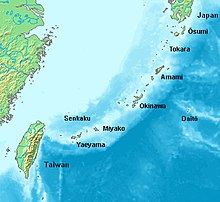
Isle arcs tin either be agile or inactive based on their seismicity and presence of volcanoes. Active arcs are ridges of recent volcanoes with an associated deep seismic zone. They also possess a singled-out curved form, a concatenation of active or recently extinct volcanoes, a abyssal trench, and a large negative Bouguer bibelot on the convex side of the volcanic arc. The modest positive gravity bibelot associated with volcanic arcs has been interpreted past many authors equally due to the presence of dumbo volcanic rocks below the arc. Inactive arcs are a concatenation of islands which contains older volcanic and volcaniclastic rocks.[2]
The curved shape of many volcanic chains and the angle of the descending lithosphere are related.[3] If the oceanic part of the plate is represented past the ocean flooring on the convex side of the arc, and if the zone of flexing occurs beneath the submarine trench, then the deflected function of the plate coincides approximately with the Benioff zone beneath almost arcs.
Location [edit]
Most modernistic island arcs are near the continental margins (majorly in the northern and western margins of the Pacific Ocean). Withal, no direct evidence from inside the arcs shows that they have always existed at their present position with respect to the continents, although evidence from some continental margins suggests that some arcs may have migrated toward the continents during the late Mesozoic or early Cenozoic.[2]
The movement of the island arcs towards the continent could be possible if, at some point, the ancient Benioff zones dipped toward the present ocean rather than toward the continent, as in nigh arcs today. This will have resulted in the loss of sea flooring between the arc and the continent, and consequently, in the migration of the arc during spreading episodes.[2]
The fracture zones in which some agile island arcs terminate may exist interpreted in terms of plate tectonics as resulting from movement along transform faults,[iv] [5] which are plate margins where the chaff is neither being consumed nor generated. Thus the nowadays location of these inactive island chains is due to the nowadays design of lithospheric plates. All the same, their volcanic history, which indicates that they are fragments of older isle arcs, is not necessarily related to the present plate pattern and may exist due to differences in position of plate margins in the past.
Tectonic formation [edit]

Two plates collide and create an isle arc between them in the process.
Understanding the source of oestrus that causes the melting of the mantle was a contentious problem. Researchers believed that the oestrus was produced through friction at the top of the slab. However, this is unlikely because the viscosity of the asthenosphere decreases with increasing temperature, and at the temperatures required for partial fusion, the asthenosphere would have such a low viscosity that shear melting could not occur.[6]
It is at present believed that water acts as the primary agent that drives partial melting below arcs. It has been shown that the amount of water present in the down-going slab is related to the melting temperature of the mantle.[7] The greater the corporeality of water present, the more than the melting temperature of the drapery is reduced. This water is released during the transformation of minerals every bit force per unit area increases, with the mineral carrying the most water being serpentinite.
These metamorphic mineral reactions crusade the dehydration of the upper part of the slab as the hydrated slab sinks. Heat is also transferred to it from the surrounding asthenosphere. As oestrus is transferred to the slab, temperature gradients are established such that the asthenosphere in the vicinity of the slab becomes cooler and more mucilaginous than surrounding areas, especially near the upper part of the slab. This more viscous asthenosphere is then dragged downward with the slab causing less viscid mantle to flow in backside it. It is the interaction of this down-welling drapery with aqueous fluids rising from the sinking slab that is thought to produce partial melting of the mantle as information technology crosses its moisture solidus.[8] In addition, some melts may result from the upward-welling of hot pall material within the mantle wedge.[9] If hot material rises quickly plenty so that lilliputian estrus is lost, the reduction in pressure may crusade pressure release or decompression partial melting.
On the subducting side of the island arc is a deep and narrow oceanic trench, which is the trace at the Earth's surface of the boundary between the downwardly-going and overriding plates. This trench is created by the downward gravitational pull of the relatively dense subducting plate on the leading border of the plate. Multiple earthquakes occur along this subduction boundary with the seismic hypocenters located at increasing depth under the isle arc: these quakes define the Benioff zone.[ten] [eleven]
Island arcs can exist formed in intra-oceanic settings, or from the fragments of continental crust that take migrated away from an adjacent continental land mass or at subduction-related volcanoes active at the margins of continents.
Features [edit]

A schematic cross-section of an isle arc from trench to back-arc bowl
Beneath are some of the generalized features nowadays in near island arcs.
Fore-arc: This region comprises the trench, the accretionary prism, and the fore-arc bowl. A bump from the trench in the oceanward side of the system is nowadays (Barbados in the Lesser Antilles is an example). The fore-arc basin forms between the fore-arc ridge and the isle arc; it is a region of undisturbed flat-bedded sedimentation.
Trenches: These are the deepest features of body of water basins; the deepest being the Mariana trench (approximately 11,000 grand or 36,000 ft). They are formed by flexing of the oceanic lithosphere, developing on the ocean side of island arcs.
Back-arc basin: They are also referred to as marginal seas and are formed in the inner, concave side of island arcs divisional by back-arc ridges. They develop in response to tensional tectonics due to rifting of an existing island arc.
Benioff zone or Wadati-Benioff zone: This is a airplane that dips under the overriding plate where intense volcanic activeness occurs, which is defined by the location of seismic events below the arc. Earthquakes occur from near surface to ~660 km depth. The dip of Benioff zones ranges from 30° to most vertical.[12]
An sea basin may be formed between the continental margin and the island arcs on the concave side of the arc. These basins take a chaff which is either oceanic or intermediate between the normal oceanic crust and that typical of continents; heat flow in the basins is higher than in normal continental or oceanic areas.[2]
Some arcs, such as the Aleutians, pass laterally into the continental shelf on the concave side of the arc,[13] while virtually of the arcs are separated from the continental chaff.
Movement betwixt two lithospheric plates explains the major features of active isle arcs. The island arc and small sea basin are situated on the overlying plate which meets the descending plate containing normal oceanic crust forth the Benioff zone. The sharp bending of the oceanic plate downward produces a trench.[xiv]
Volcanic rocks in the island arc [edit]
In that location are generally three volcanic series from which the types of volcanic rock that occur in island arcs are formed:[15] [16]
- The tholeiitic series – basaltic andesites and andesites.
- The calc-alkaline series – andesites.
- The alkaline series – subgroups of alkaline basalts and the rare, very loftier potassium-bearing (i.east. shoshonitic) lavas.
This volcanic serial is related to the age of the subduction zone and the depth. The tholeiitic magma series is well represented above immature subduction zones formed by magma from relative shallow depth. The calc-alkaline and element of group i serial are seen in mature subduction zones, and are related to magma of greater depths. Andesite and basaltic andesite are the most abundant volcanic rock in isle arc which is indicative of the calc-element of group i magmas. Some Island arcs have distributed volcanic series every bit can be seen in the Japanese isle arc organisation where the volcanic rocks change from tholeiite—calc-alkaline—alkaline with increasing altitude from the trench.[15]
Several processes are involved in arc magmatism which gives rise to the great spectrum of rock composition encountered. These processes are, but not limited to, magma mixing, fractionation, variations in the depth and degree of partial melting and assimilation. Therefore, the 3 volcanic serial results in a wide range of rock composition and do not correspond to accented magma types or source regions.[6]
List of modern isle arcs [edit]
| Isle arc | State | Trench | Basin or marginal sea | Overriding Plate | Subducting plate |
|---|---|---|---|---|---|
| Aleutian Islands | Us | Aleutian Trench | Bering Sea | North American Plate | Pacific Plate |
| Kuril Islands | Russia | Kuril–Kamchatka Trench | Sea of Okhotsk | North American Plate | Pacific Plate |
| Japanese Archipelago | Japan | Nihon Trench、Nankai Trough | Sea of Japan | Northward American Plate, Eurasian Plate | Pacific Plate, Philippine Sea Plate |
| Ryukyu Islands | Japan | Ryukyu Trench | East China Sea (Okinawa Trough) | Eurasian Plate | Philippine Sea Plate |
| Philippine Islands | Philippines | Philippine Trench | Southward China Bounding main, Celebes Sea | Eurasian Plate | Philippine Body of water Plate |
| Sunda Arc | Indonesia | Coffee Trench | Coffee Bounding main, Flores Sea | Eurasian Plate | Australian Plate |
| Andaman and Nicobar Islands | India | Northern Java Trench | Andaman Sea | Eurasian Plate | Indo-Australian Plate |
| Izu Islands and Bonin Islands (Ogasawara Islands) | Nippon | Izu–Ogasawara Trench | Philippine Body of water Plate | Pacific Plate | |
| Mariana Islands | U.s.a. | Mariana Trench | Philippine Bounding main Plate | Pacific Plate | |
| Bismarck Archipelago | Papua New Guinea | New Britain Trench | Pacific Plate | Australian Plate | |
| Solomon Islands (archipelago) | Solomon Islands | San Cristobal Trench | Pacific Plate | Australian Plate | |
| New Hebrides | Vanuatu | New Hebrides Trench | Pacific Plate | Australian Plate | |
| Tonga islands | Tonga | Tonga Trench | Australian Plate | Pacific Plate | |
| Antilles | Puerto Rico Trench | Caribbean | Caribbean Plate | North American Plate, S American Plate | |
| Due south Sandwich Islands | British Overseas Territory | South Sandwich Trench | Scotia Sea | Scotia Plate | S American Plate |
| Aegean or Hellenic arc | Greece | Eastern Mediterranean Trench | Aegean Bounding main | Aegean Sea Plate or Hellenic Plate | African Plate |
Examples of aboriginal island arcs [edit]
Remains of former island arcs have been identified at some locations. The tabular array below mention a selection of these.
| Island arc | Country | Fate |
|---|---|---|
| Chaitenia | Chile, Argentina | Accreted to Patagonia in the Devonian.[17] |
| Insular Islands | Canada, U.s.a. | Accreted to North America in the Cretaceous. |
| Intermontane Islands | Canada, United states | Accreted to N America in the Jurassic. |
See also [edit]
- Back-arc bowl
- High isle
- Volcanic arc
References [edit]
- ^ Taylor, S.R. (1967). "The origin and growth of continents". Tectonophysics. four (1): 17–34. Bibcode:1967Tectp...4...17T. doi:ten.1016/0040-1951(67)90056-ten. ISSN 0040-1951.
- ^ a b c d Mitchell, Andrew H.; Reading, Harold Yard. (1971). "Development of Island Arcs". The Journal of Geology. 79 (3): 253–284. Bibcode:1971JG.....79..253M. doi:x.1086/627627. ISSN 0022-1376.
- ^ FRANK, F. C. (1968). "Curvature of Island Arcs". Nature. 220 (5165): 363. Bibcode:1968Natur.220..363F. doi:10.1038/220363a0. ISSN 0028-0836.
- ^ WILSON, J. TUZO (1965). "A New Class of Faults and their Bearing on Continental Drift". Nature. 207 (4995): 343–347. Bibcode:1965Natur.207..343W. doi:10.1038/207343a0. ISSN 0028-0836.
- ^ Isacks, Bryan; Oliver, Jack; Sykes, Lynn R. (1968-09-fifteen). "Seismology and the new global tectonics". Journal of Geophysical Inquiry. 73 (18): 5855–5899. Bibcode:1968JGR....73.5855I. doi:x.1029/jb073i018p05855. ISSN 0148-0227.
- ^ a b England, Richard West. (2009). "Philip Kearey, Keith A. Klepeis and Frederick J. Vine: Global tectonics". Marine Geophysical Researches. 30 (4): 293–294. Bibcode:2009MarGR..thirty..293E. doi:10.1007/s11001-010-9082-0. ISSN 0025-3235.
- ^ Stolper, Edward; Newman, Sally (1994). "The role of h2o in the petrogenesis of Mariana trough magmas". Globe and Planetary Science Letters. 121 (3–iv): 293–325. Bibcode:1994E&PSL.121..293S. doi:x.1016/0012-821x(94)90074-four. ISSN 0012-821X.
- ^ Tatsumi, Yoshiyuki (1989-04-x). "Migration of fluid phases and genesis of basalt magmas in subduction zones". Periodical of Geophysical Research: Solid Earth. 94 (B4): 4697–4707. Bibcode:1989JGR....94.4697T. doi:10.1029/JB094iB04p04697. ISSN 2156-2202.
- ^ Sisson, T. W.; Bronto, Due south. (1998). "Evidence for pressure level-release melting below magmatic arcs from basalt at Galunggung, Indonesia". Nature. 391 (6670): 883–886. Bibcode:1998Natur.391..883S. doi:x.1038/36087. ISSN 0028-0836.
- ^ Toksöz, Thousand. Nafi (1975). "The Subduction of the Lithosphere". Scientific American. 233 (v): 88–98. Bibcode:1975SciAm.233e..88T. doi:ten.1038/scientificamerican1175-88. ISSN 0036-8733.
- ^ Hacker, Bradley R.; Peacock, Simon M.; Abers, Geoffrey A.; Holloway, Stephen D. (2003). "Subduction factory 2. Are intermediate-depth earthquakes in subducting slabs linked to metamorphic dehydration reactions?". Periodical of Geophysical Inquiry: Solid Earth. 108 (B1): 2030. Bibcode:2003JGRB..108.2030H. doi:ten.1029/2001jb001129. ISSN 0148-0227.
- ^ Condie, Kent C. (1987), "Benioff zone", Structural Geology and Tectonics, Encyclopedia of Earth Science, Kluwer Academic Publishers, pp. 29–33, doi:x.1007/iii-540-31080-0_7, ISBN978-0442281250
- ^ Menard, H. Due west. (1967-06-15). "Transitional types of crust under small sea basins". Periodical of Geophysical Inquiry. 72 (12): 3061–3073. Bibcode:1967JGR....72.3061M. doi:10.1029/jz072i012p03061. ISSN 0148-0227.
- ^ Oxburgh, East. R.; Turcotte, D. L. (1970). "Thermal Construction of Island Arcs". Geological Order of America Bulletin. 81 (6): 1665. doi:10.1130/0016-7606(1970)81[1665:tsoia]2.0.co;2. ISSN 0016-7606.
- ^ a b Gill, J.B. (1982). "Andesites: Orogenic andesites and related rocks". Geochimica et Cosmochimica Acta. 46 (12): 2688. doi:10.1016/0016-7037(82)90392-one. ISSN 0016-7037.
- ^ Hall, A. (1982). "R. Southward. Thorpe, Editor. Andesites: Orogenic Andesites and Related Rocks. Chichester, New York, Brisbane, Toronto, and Singapore (John Wiley and Sons), 1982. xiii+724 pp., 277 figs. Price £59·50". Mineralogical Magazine. 46 (341): 532–533. doi:ten.1180/minmag.1982.046.341.31. ISSN 0026-461X.
- ^ Hervé, Francisco; Calderón, Mauricio; Fanning, Mark; Pankhurst, Robert; Rapela, Carlos W.; Quezada, Paulo (2018). "The country rocks of Devonian magmatism in the North Patagonian Massif and Chaitenia". Andean Geology. 45 (3): 301–317. doi:ten.5027/andgeoV45n3-3117.
Source: https://en.wikipedia.org/wiki/Island_arc
0 Response to "What Leads to the Creation of Island Arcs"
Post a Comment